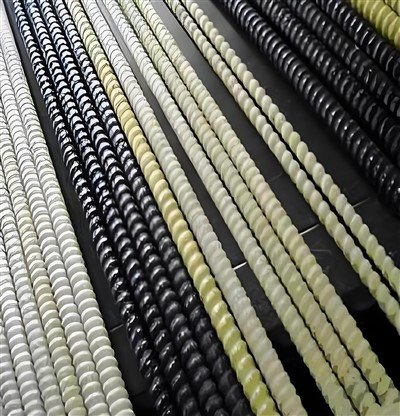
Coil-Supplied GFRP Reinforcing Bar is glass fiber reinforced polymer reinforcement supplied in continuous coils for selected concrete reinforcement and fabrication applications. Continuous glass fibers embedded in a polymer resin matrix provide tensile reinforcement, while the external surface profile supports bond with concrete. The coil format supports continuous feeding, length measurement, and cutting for repetitive reinforcement layouts. Product diameter, coil length, surface configuration, and mechanical properties are specified according to project requirements and confirmed manufacturing capabilities.
Continuous coil supply supports repetitive cutting operations and reduces the need to handle individual straight bars in suitable production layouts.
Specified cutting lengths can be coordinated with reinforcement schedules to support material planning and repeatable fabrication.
GFRP has a lower material density than steel, reducing the weight of reinforcement handled and transported for comparable material volumes.
The nonmetallic composite structure provides resistance to conventional steel reinforcement corrosion. Suitability depends on the product specification and concrete exposure conditions.
|
|
|
|
|
Coil-Supplied GFRP Reinforcing Bar |
|
|
|
|
|
|
|
Cross-Section |
|
|
|
6, 8, 10, 12 mm |
|
Cross-Sectional Area |
28.3, 50.3, 78.5, 113.1 mm² |
|
|
50, 100, 200 m |
|
|
Deformed or Sand-Coated |
|
|
Minimum 900 to 1000 MPa |
|
|
Minimum 45 GPa |
|
|
0.06, 0.11, 0.17, 0.24 kg/m |
|
|
0.25 to 0.30 mm |
|
|
|
|
|
Suitable for evaluation in slab and pavement reinforcement layouts where the specified diameter, spacing, and installation procedure permit coiled reinforcement.
Continuous supply can support repetitive cutting and placement in precast facilities with established reinforcement schedules and handling procedures.
Applicable to selected concrete foundation and ground-supported structures when permitted by the structural design and project specification.
GFRP reinforcement can be specified for suitable infrastructure projects where corrosion resistance and nonmetallic reinforcement are relevant design requirements.
Specify the nominal diameter, required metres per coil, and total linear metres. Available combinations depend on production capability and coil-handling limits.
Surface configuration and resin system can be reviewed against bond requirements, environmental exposure, and the applicable product specification.
Coil dimensions, securing method, protective packaging, and batch labels can be coordinated with transport, storage, and receiving requirements.
Project-Based Production
Technical drawings, reinforcement schedules, quantity requirements, and delivery targets provide the basis for evaluating customized production.
Fiber and resin identification records support material traceability and production control.
Relevant production controls include process parameters, curing conditions, and finished-bar surface consistency, according to the established manufacturing procedure.
Bar dimensions and applicable tolerances should be checked against the approved product specification.
Tensile strength, tensile modulus, and other specified properties should be supported by applicable test methods and recorded results.
Production identification and associated inspection records, where maintained, help connect supplied material with its manufacturing and quality documentation.
Product specifications can identify nominal diameter, surface profile, material composition, mechanical properties, dimensional tolerances, and applicable test methods.
Dimensional inspection records can document measured product dimensions against the applicable product specification.
Relevant mechanical test reports can document measured properties, test methods, and the tested product configuration.
Applicable standards and technical requirements should be confirmed against the product configuration and project specifications. Compliance statements should be supported by relevant test results and valid documentation.
Coils should be secured for transport. Package dimensions, gross weight, and unloading arrangements should be confirmed before dispatch.
Use a suitable controlled-release arrangement and follow the product-specific handling procedure. Stored energy in coiled material requires controlled unwinding and appropriate personnel protection.
Store coils on stable supports in a clean, dry area. Protect the material from impact, surface damage, and exposure outside the specified storage conditions.
Use suitable cutting equipment and follow the approved installation procedure. Field bending or straightening should only be performed when expressly permitted by the product documentation.
It-tags Popolari: coil-supplied gfrp reinforcing bar, China coil-supplied gfrp reinforcing bar manufacturers, suppliers